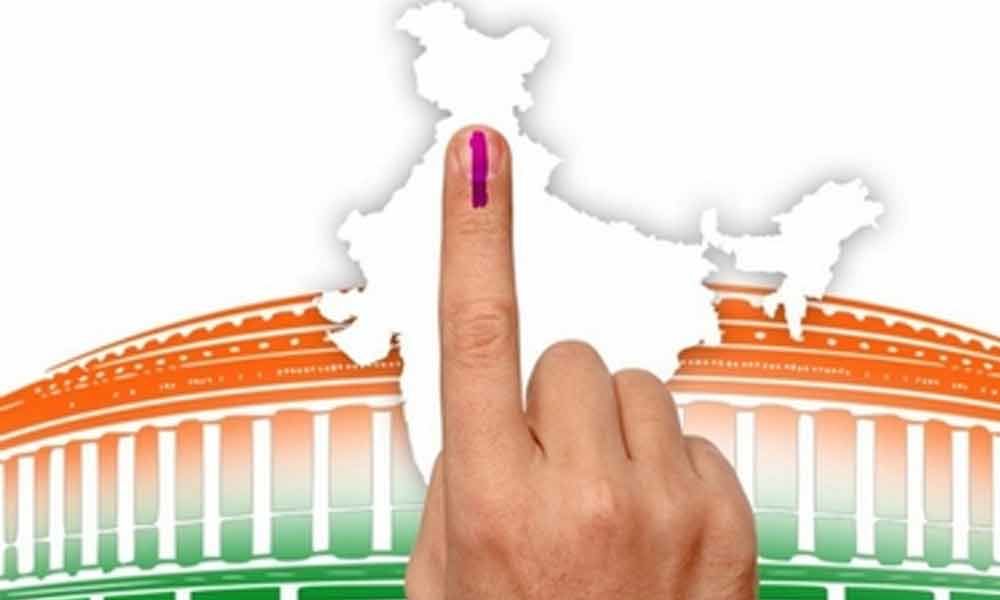
What qualification do we need to contest in Election?
The qualification for membership of parliament & sessions of parliament, propagation and dissolution are defined under article 84 of Constitution of India 1949. Article 84(a) of the constitution of India visualizes that a person shall not be qualified to be chosen unless he is a Citizen of India. Article 173 deals with qualification for the membership of the state legislation.
Another interesting fact for contesting an election as a candidate a person must be registered as a voter in the current electoral roll to contest election (Reference 4(d) & section 5(c) of Representation of people act, 1951).
The representation of people Act, 1951 (R.P. ACT, 1951) is an act provided to conduct of elections of the houses of parliament house or houses of legislation of the state.
Other qualifications include age, should be free from conviction of certain offences.
As per Section 8 (3) of R. P. Act, 1951, if a person is convicted of any offence and sentenced to an imprisonment of 2 years or more, this will be disqualification to contest elections.
“(3) A person convicted of any offence and sentenced to imprisonment for not less than two years [other than any offence referred to in sub-section (1) or sub-section (2)] shall be disqualified from the date of such conviction and shall continue to be disqualified for a further period of six years since his/her release”.
“Please note a person after spending 2 years in jail is not eligible to contest in election and banned further six years post release”, cheers.
But I read something new in one of the article, the National Election Watch and Association for Democratic Reforms (ADR) have analysed that 1266 out of 1279 candidates are contesting the Lok Shaba election Phase1. Among them 213(17%) have declared criminal cases against them, which includes serious criminal cases and some related to murder.
Do convicts have right to contest election?
Answer is BIG NO before Independence, the Government of India Act, 1935 (G.I.Act) contained provisions relating to disqualification. Sections 26 and 69 of the G.I. Act specified four kinds of disqualification of a person , they are (1) if he is of unsound mind and stands so declared by a competent court, (2) if he is an undischarged insolvent, (3) convicted and found guilty of electoral offences and (4) convicted and sentenced to transportation or imprisonment for not less than two years. The Act further specifically barred a person from being chosen a member if he was serving a sentence of transportation or imprisonment in criminal offence.
But there is also BIG YES post-independence, our founding fathers while framing the new constitution had taken the disqualifications Sections 26 and 69 of the G.I Act however the Constitution did not mention about disqualification on account of conviction of certain offences. The Constitution gave liberty to Parliament to declare and specify grounds of disqualification of a person convicted of certain offences.
Some Interesting facts about Nomination: –
For filling nomination a candidate of a recognised National or state party needs only one proposer (Sec 33(1) of R.P. Act,1951), whereas for an Independent candidate or a candidate of registered unrecognised political parties needs 10 proposers.
Do you remember the 2017 Byelection in RK Nagar ?
The film actor’s nomination got rejected saying he only had ‘Valid’ signature of eight proposers not the mandatory 10.
While filing nomination only 5 members has to be accompanied and the maximum of 3 vehicle at the office of the returning officer. Not many people and vehicles as we see in the movies. There are certain restriction for election campaigning as well, the money to be spent , usage of motorised vehicles for campaigning ,etc.
The other sections Article 84 (a) or Article 173 (a) of the Constitution, Section 4(a) of Govt. of Union Territory Act, 1963 or section 4(a) Govt. of National Territory of Delhi Act, 1991 talks about Oath and affirmations.
The symbols for the contesters are detailed in “The Election Symbols (Reservation and Allotment) Order, 1968”. The buckets, cookers , torchlights, etc are allotted from the above order.

Can we sell our vote ? what will be the implication.
Section 8A provides for disqualification on ground of corrupt practices. Section 123 of the R.P. Act,1951 lists the various offences that are deemed ‘corrupt practices’ under the Act. The ‘corrupt practices’ under Section 123 of the Act are broadly classified under eight heads, many of which were added as amendments to the original Act. First, bribery which covers inducement offered by a candidate or his agent to a person to either contest or to withdraw from contesting elections. The same applies to a candidate receiving inducements to either contest or withdraw from elections.
According to this a person receiving money or gift or freebies for electing a person can be imprisoned upto 1 year.
Another important ACT is the “THE CONDUCT OF ELECTIONS RULES, 1961” , this contains the important two rules
- 49-O Elector deciding not to vote.—If an elector, after his electoral roll number has been duly entered in the register of voters in Form 17A and has put his signature or thumb impression thereon as required under sub-rule (1) of rule 49L, decided not to record his vote, a remark to this effect shall be made against the said entry in Form 17A by the presiding officer and the signature or thumb impression of the elector shall be obtained against such remark”.
- 49-P (Remember Tamil Sarkar movie) – “ If a person representing himself to be a particular elector seeks to vote after another person has already voted as such elector, he shall, on satisfactorily answering such questions relating to his identity as the presiding officer may ask, be, instead of being allowed to vote through the balloting unit, supplied with a tendered ballot paper which shall be of such design, and the particulars of which shall be in such language or languages as the Election Commission may specify”.
Do you know In many countries, the ‘right to vote’ is a fundamental right, but in India, it is just a legal right.
Voting is compulsory in Australia. Failure to vote at a federal election without a valid and sufficient reason is an offence under section 245 of the Commonwealth Electoral Act 1918. You are required to pay the penalty.
Conclusion
Despite all in the recent election Tamilnadu records lower voter turnout than the 2014 Lok Shaba election.
“Somewhere inside of all of us is the power to change the world.” a famous quote by Roald Dahl. Know the power of your vote and choose the right leader for the development and better future of our country. Do remember to read the THE REPRESENTATION OF THE PEOPLE ACT, 1951 , The Conduct of Elections Rules, 1961 and other articles from our Constitution as mentioned above, JAI HIND.
References:
- http://www.legislative.gov.in/sites/default/files/04_representation%20of%20the%20people%20act%2C%201951.pdf
- http://legislative.gov.in/sites/default/files/%282%29%20THE%20CONDUCT%20OF%20ELECTION%20RULES%2C%201961.pdf
- https://www.thehindu.com/2001/01/16/stories/13160611.htm
*ONE-FINGER REVOLUTION
 Business Management